
State Government Return To Office Policies [2026]
Last updated: June 2026. We update this page as policies change.
Unlike federal employees (where a single presidential memo governs everyone) state government workers operate under 50 different policies set by 50 different governors. Some states ordered employees back full-time. Others maintained hybrid schedules. Some governors actively blocked their own legislatures from mandating RTO. A few reversed course entirely.
This page tracks the return-to-office policy for state government employees across all 50 states. The top 15 most notable state policies are covered in full below. Download the complete 50-state dataset to see every state.
Table of Contents
State Government RTO Statistics
According to primary research we conduct at Buildremote, here are the key takeaways from our study of all 50 states:
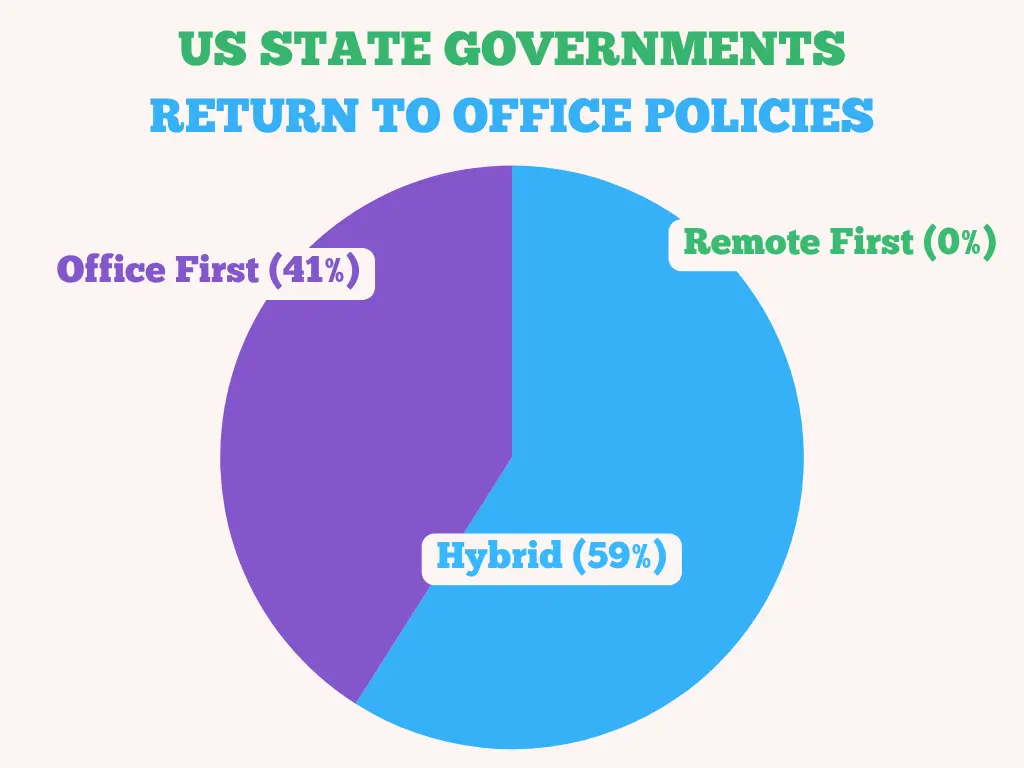
- 9 states have issued formal Office First mandates requiring full-time or near full-time in-person work
- 13 states have published hybrid policies with specific day or percentage requirements
- 28 states have no publicly stated statewide policy — telework is left to agency or manager discretion
- Party split is stark: nearly every Office First mandate was issued by a Republican governor. The notable exception is New Mexico, where Democratic Gov. Michelle Lujan Grisham ordered full-time RTO in February 2023 — earlier than any Republican governor
- Texas is the most dramatic case — Gov. Abbott ordered full-time RTO in March 2025, then reversed it by signing HB 5196 just three months later, after bipartisan legislative rebellion
- California ordered 4 days/week, but unions delayed it a full year — the mandate is now scheduled for July 1, 2026
- Nebraska was the first state to mandate full-time RTO: Gov. Pillen ordered employees back by January 2, 2024, over a year before the federal mandate
See Also: US Federal Government Return to Office Tracker | City & County Government RTO Policies
RTO Policies For 15 Notable States
Below are the 15 most notable state government return-to-office policies, ordered by significance and newsworthiness. Download the full 50-state dataset for complete coverage.
1. Texas
- Governor: Greg Abbott (R)
- Policy: Agency discretion
- Office days: Varies by agency
- Effective date: September 1, 2025
- Notes: Abbott directed all state agencies to end telework in March 2025. Within weeks, agencies struggled to find office space and parking for ~150,000 employees — the state had already downsized much of its real estate footprint. Texas’s own productivity data showed remote work had not decreased service quality. In a bipartisan rebellion (House vote: 132-11), the legislature passed HB 5196, allowing agencies to craft their own remote work policies. Abbott signed it on June 26, 2025, reversing his own mandate in just three months. HB 5196 requires agencies to review telework arrangements annually; telework cannot be a condition of employment.
- Source: Federal News Network
2. California
- Governor: Gavin Newsom (D)
- Policy: Hybrid
- Office days: 4 days/week
- Effective date: July 1, 2026 (delayed from July 1, 2025)
- Notes: Newsom signed Executive Order N-22-25 in March 2025, requiring all hybrid state workers (~108,000 employees) to return 4 days/week by July 1, 2025. Unions negotiated a one-year delay: SEIU Local 1000 (~96,000 members) traded pay concessions for the postponement, accepting 5 extra unpaid hours per month instead of a pay raise. Critics called the mandate politically motivated; the governor’s office said it was about productivity and public trust. As of June 2026, agencies are preparing for the July 1 implementation, with SEIU still filing Unfair Labor Practice charges with PERB.
- Source: CalMatters
3. Oklahoma
- Governor: Kevin Stitt (R)
- Policy: Office First
- Office days: 5 days/week
- Effective date: February 1, 2025
- Notes: One of the earliest and strictest state mandates. Executive Order 2024-29 (signed December 2024): “State agencies shall require all full-time employees to perform their work in the office, facility, or field location assigned by their agency, and not from a remote location by February 1, 2025.” Exceptions require cabinet secretary approval. Non-compliance: termination. Stitt doubled down as late as September 2025, with agencies reporting compliance numbers monthly to the Office of Management and Enterprise Services.
- Source: News9
4. Nebraska
- Governor: Jim Pillen (R)
- Policy: Office First
- Office days: 5 days/week
- Effective date: January 2, 2024
- Notes: Nebraska was the first state in the country to mandate full-time RTO — over a year before the federal mandate and before most Republican governors acted. Pillen ordered state employees back full-time by January 2, 2024, affecting approximately 2,250 employees who had been working remotely or hybrid since the pandemic. Cited alignment with private sector practices and government efficiency.
- Source: Nebraska Examiner
5. Indiana
- Governor: Mike Braun (R)
- Policy: Office First
- Office days: 5 days/week
- Effective date: July 2025
- Notes: Braun issued Executive Order 2025-16, requiring state workers back by July 2025 (notably one week before Trump’s federal mandate). The order included “limited exceptions,” which analysts noted was signaling room for negotiation from day one. Federal News Network described Indiana as following a new state-level playbook: announce sweeping mandates, create urgency, then trade flexibility for other budget concessions.
- Source: Federal News Network
6. Missouri
- Governor: Mike Kehoe (R)
- Policy: Office First
- Office days: 5 days/week
- Effective date: March 24, 2025
- Notes: Kehoe’s Office of Administration sent an internal memo requiring return: supervisors and managers back by February 25, all remaining remote workers by March 24, 2025. About one-third of Missouri’s ~50,000 state employees had worked remotely during COVID. Agency directors told state lawmakers there are ongoing concerns about losing low-paid workers to the private sector if remote work ends.
- Source: St. Louis Post-Dispatch
7. Arkansas
- Governor: Sarah Huckabee Sanders (R)
- Policy: Office First
- Office days: 5 days/week
- Effective date: October 1, 2025
- Notes: Sanders announced the “Arkansas Forward” initiative on August 28, 2025, ending regular telework for all executive branch employees effective October 1. One of the later state mandates, but among the most comprehensive in scope.
- Source: Office of Governor Sanders
8. Louisiana
- Governor: Jeff Landry (R)
- Policy: Office First
- Office days: 5 days/week
- Effective date: July 1, 2025
- Notes: Executive Order JML 25-048 (signed April 23, 2025) requires full-time in-person work and ends remote work for all executive branch departments and agencies under the governor’s authority. One of the more formal executive order mandates at the state level.
- Source: Louisiana Governor’s Office
9. New Mexico
- Governor: Michelle Lujan Grisham (D)
- Policy: Office First
- Office days: 5 days/week
- Effective date: February 2, 2023
- Notes: The most notable outlier in the state RTO data: a Democratic governor who ordered full-time RTO earlier than any Republican governor. State Personnel Office director memo (November 29, 2022) rescinded pandemic telework policy. Managers returned January 3, 2023; full return February 2, 2023. New Mexico’s early and strict mandate went largely unnoticed nationally because it predated the wave of Republican governor mandates by over a year.
- Source: Santa Fe New Mexican
10. Minnesota
- Governor: Tim Walz (D)
- Policy: Hybrid
- Office days: 50% of time in the office
- Effective date: June 1, 2025
- Notes: Walz announced in March 2025 that most state employees must work in the office at least half the time, effective June 2025. The Minnesota Association of Professional Employees (MAPE) said they weren’t consulted and questioned whether the state was ready for the shift. Notably, one of several Democratic governors who have pushed for more in-office time, showing the RTO trend is not purely partisan at the state level.
- Source: Minnesota Star Tribune
11. Maryland
- Governor: Wes Moore (D)
- Policy: Hybrid
- Office days: 2 days/week minimum
- Effective date: May 15, 2024
- Notes: Maryland’s Department of Budget and Management established a post-pandemic telework policy requiring a minimum of 2 days/week in-office and 2 days remote for telework-eligible employees. The fifth workday is determined by the manager. Full-time telework requires agency head approval. Gov. Moore has been more focused on supporting Maryland’s large population of federal workers impacted by Trump’s RTO than issuing state-level mandates.
- Source: Maryland DBM
12. South Carolina
- Governor: Henry McMaster (R)
- Policy: Hybrid
- Office days: 3 days/week minimum (max 2 days remote)
- Effective date: September 12, 2025
- Notes: Executive Order 2025-31 limits state employees to a maximum of 2 days/week of telework. Certain management-level positions are prohibited from teleworking at all. Requires agency-specific telecommuting plans approved by the Division of State Human Resources. A notably moderate approach for a Republican governor — a hybrid cap rather than a full mandate.
- Source: Office of Governor McMaster
13. Vermont
- Governor: Phil Scott (R)
- Policy: Hybrid
- Office days: 3 days/week (contested)
- Effective date: December 2025 (phased through July 2026), contested and shot down April 2026
- Notes: The mandate (3 days/week) took effect on Dec 1, 2025, for ~3,000 employees. 552 out-of-state workers were given until Jul 1, 2026, to comply or be replaced. 3,500+ employees signed a petition opposing the plan. In April 2026, the Vermont Labor Relations Board overturned the mandate, ruling the state had refused to bargain in good faith. The board ordered the state to rescind the policy and compensate affected employees for monetary losses, including commute costs. Scott called the ruling ‘biased’ and is appealing to the Vermont Supreme Court.
- Source: VTDigger
14. Wisconsin
- Governor: Tony Evers (D)
- Policy: Not Stated (mandate blocked)
- Office days: Agency discretion
- Effective date: N/A
- Notes: Republican lawmakers introduced a bill requiring state employees to return to the office full-time by July 1, 2025. Evers pledged to veto any such mandate, and the bill never advanced. Wisconsin is the clearest example of a governor actively protecting state employee telework against legislative pressure. There is no statewide policy in place as of December 2025.
- Source: Wisconsin.gov
15. Utah
- Governor: Spencer Cox (R)
- Policy: Not Stated
- Office days: ~2 days/week minimum (varies by agency)
- Effective date: Under review
- Notes: Utah’s case is the most ironic in the dataset. Cox was once America’s most vocal government champion of telework — as lieutenant governor he launched a nationally recognized pilot in 2018 and called himself “a televangelist for telework.” He’s now walking it back. Many agencies have moved to requiring at least 2 days/week in-office. No formal statewide mandate has been issued; Cox said in January 2025 “there will be more to come.” The legislature also quietly repealed the state’s “surge remote work on bad air days” program (HB404, effective May 7, 2025).
- Source: Utah News Dispatch
Want to see all 50 states? Download the complete dataset below.
[email capture / full 50-state spreadsheet download goes here]
Notable RTO Stories By State
Texas: The Three-Month Reversal
No state RTO story was more dramatic than Texas in 2025. Abbott ordered full-time return in March, agencies scrambled to find desk space they’d already given up, and by June a bipartisan legislature had passed HB 5196 (132-11 in the House) reversing the mandate entirely. Texas’s own productivity study showed remote work hadn’t decreased service quality — it had actually improved it while reducing turnover. Abbott signed the reversal bill on June 26, 2025, just three months after his original directive. (Federal News Network)
California: Paying to Stay Home
Newsom’s 4-day mandate became a bargaining chip. When unions pushed back, the state negotiated a one-year delay — but workers paid for it. SEIU Local 1000 members accepted 5 extra unpaid hours per month (effectively a 3% pay cut) in exchange for keeping their hybrid schedules through July 2026. Critics called it proof the mandate was political. Supporters said it was fiscal discipline. The state had estimated continued telework would save ~$225 million per year in real estate costs — yet still ordered workers back. (CalMatters)
New Mexico: The Democrat Who Got There First
When Republican governors started mandating RTO in 2025, few noticed that Democratic Governor Michelle Lujan Grisham had already done it — in February 2023, over two years earlier. New Mexico quietly became one of the strictest state-level RTO cases in the country, with no fanfare, no bipartisan drama, and no reversal. (Santa Fe New Mexican)
Utah: The Telework Evangelist Changes His Mind
Spencer Cox built his reputation as the most pro-telework governor in America. In 2018 he launched a nationally acclaimed pilot program. In 2020 he championed remote work through the pandemic. By 2025 he was saying “it’s not healthy to be isolated” and walking the policy back. The shift illustrates how much the political calculus around telework changed between 2020 and 2025. (Deseret News)
Vermont: The Out-of-State Problem
Vermont discovered 552 of its ~6,000 state workers lived out of state — a legacy of pandemic-era remote hiring. Scott’s mandate required them to return to in-person work or lose their jobs. It was a preview of a problem many states hadn’t fully reckoned with: what happens to workers hired as fully remote when the rules change? (VTDigger)
Definitions
Return to office: For state governments, the date a state required employees to resume in-person work at their official duty stations, reversing pandemic-era telework and remote work arrangements.
- Office First: A formal mandate requiring employees to work in-person full-time (typically 5 days/week). Telework permitted only for narrow exceptions.
- Hybrid: A published policy with specific day or percentage requirements — employees split time between office and home on a set schedule.
- Not Stated: No public statewide policy found. Telework is left to the agency or manager’s discretion. Includes states with administrative telework framework documents but no day-count requirements.
We update this page monthly. If a policy is out of date, contact us and we’ll update it right away.
Company Policies
