
US Federal Government Return to Office Tracker [2026]

Last updated: June 2026. We update this page as policies change.
On January 20, 2025, his first day back in office, President Trump signed a presidential memorandum ordering all federal employees to return to work in-person full-time. Every telework and remote work agreement was terminated.
This page tracks the return-to-office policy for all 24 CFO Act agencies (+ three agencies with their own, distinct policies): the federal departments that cover 95% of all federal spending and employment. The data is free. You can download the full spreadsheet below.
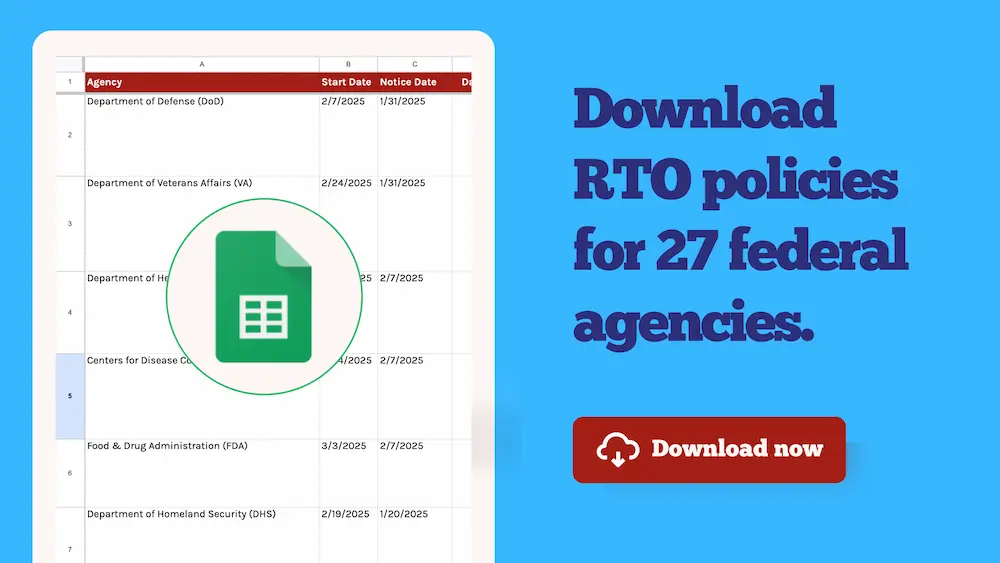
Table of Contents
- Federal RTO statistics
- The governing directive
- Every federal agency’s RTO policy
- Notable stories by agency
- Executive order timeline
- Is telework coming back?
- Definitions
Federal Return to Office Statistics
According to primary research we conduct at Buildremote, here are the key takeaways from our study of all 24 federal agencies:
- 100% of CFO Act agencies were ordered to return to full-time, in-person work under the January 20, 2025 presidential memorandum
- All 24 agencies were required to submit RTO implementation plans by February 7, 2025, per a joint OPM/OMB memo
- 23 of 24 agencies are operating at a 5-day/week in-person standard
- 1 agency (DOL) partially walked back its RTO in July 2025, expanding situational telework beyond OPM’s minimum
- 46% of remote-capable federal workers were fully in-office by Q2 2025, vs. 21% for the private sector, per Gallup
- ~90% of all federal employees are working on-site full-time as of early 2026, per OPM Director Scott Kupor
- 4 agencies have faced arbitration rulings ordering partial restoration of telework for union members: HHS, HUD, SSA, and USPTO
- Multiple agencies reported space shortages — employees shared desks, worked from closets, or were assigned to storage facilities
See Also: US State Government RTO Policies | City & County Government RTO Policies
The Governing Directive
Unlike the Fortune 500, where RTO is a corporate decision made company by company, federal agency RTO flows from a single presidential order, with agency heads implementing it on their own timelines.
“Heads of all departments and agencies in the executive branch of Government shall, as soon as practicable, take all necessary steps to terminate remote work arrangements and require employees to return to work in-person at their respective duty stations on a full-time basis.” — Presidential Memorandum, January 20, 2025
OPM and OMB issued joint guidance on January 27, 2025, setting February 7 as the deadline for agencies to submit implementation plans. Each agency then set its own specific start dates, handled union contract complications, and dealt with the reality of offices that had been downsized or repurposed since 2020.
The 50-mile rule: Employees whose home is more than 50 miles from an agency office are phased in separately. Agencies are required to relocate their official duty station to the nearest appropriate office.
Exemptions are allowed for disability, qualifying medical condition, military spouses, and other “compelling reasons” certified by the agency head. In practice, the exemption process has been a major source of friction — the IRS had a backlog of over 8,000 accommodation requests by late 2025.
Every Federal Agency’s RTO Policy
Below is the return-to-office policy for each of the 24 CFO Act agencies. Policies are listed alphabetically by department.
1. Department of Agriculture (USDA)
- Employees: ~100,000
- RTO date: February 2025
- Notice date: February 7, 2025
- Office days: 5 days/week
- Policy: Office First
- Notes: Pre-mandate policy allowed minimum 2 core days for managers and 1 core day for other telework-eligible staff — all rescinded. One employee was assigned to report to a federal “office” that turned out to be a storage unit used to store a Fish & Wildlife boat, with no heat, windows, or power. USDA insisted all assignments had been made through a “systematic process.”
- Source: NPR
2. Department of Commerce
- Employees: ~47,000
- RTO date: January 24, 2025
- Notice date: January 24, 2025
- Office days: 5 days/week
- Policy: Office First
- Notes: One of the fastest agency responders. Internal memo obtained by Federal News Network stated: “All current telework agreements must be cancelled immediately.” Situational telework only permitted in writing with justification. USPTO, OIG, and the NOAA Commissioned Officer Corps were carved out of the memo but remain subject to the broader presidential mandate.
- Source: Federal News Network
3. Department of Defense (DoD)
- Employees: ~900,000
- RTO date: February 7, 2025 (phased — see notes)
- Notice date: January 31, 2025
- Office days: 5 days/week
- Policy: Office First
- Notes: Phased by seniority and distance from duty station. Employees within 50 miles: back by February 7. SES and highly qualified experts beyond 50 miles: February 7. GS-15 and senior professionals beyond 50 miles: late February. All other employees: no later than June 2, 2025. Situational telework permitted on rare case-by-case basis only. Space shortages reported at some facilities. GAO found virtually all non-exempt employees were back as of July 31, 2025.
- Source: Federal News Network, Government Executive
4. Department of Education
- Employees: ~4,200
- RTO date: February 24, 2025
- Notice date: February 7, 2025
- Office days: 5 days/week
- Policy: Office First
- Notes: The agency announced that 70%+ of its workforce had returned to designated duty stations by February 24, with full compliance targeted by June 1, 2025, pending building renovations and relocation. Pre-mandate, over half of the department’s 4,245 employees never came to the office at all. The RTO coincided with ~2,000 employee departures via buyouts and layoffs, plus 465 additional layoffs during the government shutdown (later reversed).
- Source: Department of Education
5. Department of Energy (DOE)
- Employees: ~14,000 federal (plus ~95,000 contractors)
- RTO date: February 2025
- Notice date: February 7, 2025
- Office days: 5 days/week
- Policy: Office First
- Notes: DOE’s national labs and field sites are largely in-person by nature. The department had already exceeded the Biden administration’s 50% in-office target before the 2025 mandate. DOE is also subject to Trump’s March 2025 executive order on collective bargaining national security exclusions.
- Source: Federal News Network
6. Department of Health & Human Services (HHS)
- Employees: ~80,000
- RTO date: February 24, 2025
- Notice date: February 7, 2025
- Office days: 5 days/week
- Policy: Office First
- Notes: Employees more than 50 miles from an HHS facility were phased in by April 28. As of September 2025, all telework requests require approval at the assistant secretary level — not from supervisors — creating a significant bottleneck. In January 2026, an arbitrator ruled that HHS violated its 2023–2028 collective bargaining agreement with NTEU by unilaterally ending telework, and ordered the agency to reinstate it for union members. HHS is appealing.
- Source: Federal News Network
7. Department of Homeland Security (DHS)
- Employees: ~260,000
- RTO date: February 19, 2025
- Notice date: January 20, 2025
- Office days: 5 days/week
- Policy: Office First
- Notes: DHS ordered all employees in-person within 30 days of the January 20 memo, with exceptions for physical inability or lack of adequate office space. Agency leaders were required to report within 30 days which workers had not returned and why.
- Source: Axios
8. Department of Housing & Urban Development (HUD)
- Employees: ~8,800
- RTO date: February 2025
- Notice date: February 7, 2025
- Office days: 5 days/week
- Policy: Office First
- Notes: Pre-mandate data showed 828 of HUD’s 8,818 employees never came to the office, and those who did spent only 37.1% of their work time in person. In February 2026, an arbitrator ruled HUD violated its collective bargaining agreement by ending telework, and ordered restoration for approximately 7,000 AFGE Council 222 employees. HUD is appealing.
- Source: FedTools
9. Department of the Interior (DOI)
- Employees: ~70,000
- RTO date: March 4, 2025
- Notice date: January 24, 2025
- Office days: 5 days/week
- Policy: Office First
- Notes: About 55% of DOI’s workforce — National Park Service rangers, BLM field staff, wildlife officers — was already in-person full-time before the mandate. Personnel Bulletin PB 25-01 was issued March 4, 2025, establishing the revised telework policy. Telework is now voluntary and only approved when deemed in the best interest of the department. One BLM employee was reportedly assigned to report to a storage unit with no heat, windows, or power.
- Source: Department of the Interior
10. Department of Justice (DOJ)
- Employees: ~115,000
- RTO date: February 24, 2025
- Notice date: February 5, 2025
- Office days: 5 days/week
- Policy: Office First
- Notes: Attorney General Pamela Bondi issued the RTO directive on her first day (February 5, 2025) as one of 14 Day 1 memos. Applies to all DOJ components including the FBI, DEA, ATF, and Bureau of Prisons. Disability accommodation denials at DOJ have been widely documented, including cases where employees with documented conditions were initially denied and later settled with the agency.
- Source: Defender Services Office
11. Department of Labor (DOL)
- Employees: ~15,000
- RTO date: February 2025
- Notice date: February 7, 2025
- Office days: 5 days/week*
- Policy: Modified
- Notes: DOL is the only agency that partially walked back its RTO posture. A July 28, 2025 memo expanded situational telework to include doctors’ appointments, illness when still able to work, and days when employees are traveling for work. This went beyond the narrow emergency-only standard most agencies maintained. Full-time in-office remains the default; situational telework requires advance supervisory approval and cannot substitute for routine remote work.
- Source: Bloomberg Law
12. Department of State
- Employees: ~75,000
- RTO date: March 1, 2025 (telework); July 1, 2025 (remote workers)
- Notice date: January 20, 2025
- Office days: 5 days/week
- Policy: Office First
- Notes: Two-stage implementation: almost all telework cancelled on March 1, 2025; remote workers required in office by July 1, 2025. Overseas and Foreign Service situations handled separately.
- Source: Axios
13. Department of Transportation (DOT) / FAA
- Employees: ~55,000
- RTO date: February 2025
- Notice date: February 7, 2025
- Office days: 5 days/week
- Policy: Office First
- Notes: FAA employees in Aviation Safety (AVS) whose home was their Official Duty Station faced uncertain status. The FAA’s PASS union noted the agency “does not have a fully developed plan” for implementation. IT equipment shortages were reported due to spending freezes, with workers unable to purchase monitors. During the October–November 2025 government shutdown, FAA staffing shortages at air traffic control facilities triggered a safety emergency order reducing flights at 40 major airports; the order was lifted November 17 after the government reopened.
- Source: PASS National
14. Department of the Treasury
- Employees: ~100,000
- RTO date: March 10, 2025
- Notice date: February 28, 2025
- Office days: 5 days/week
- Policy: Office First
- Notes: March 10 deadline applied to employees within 50 miles of an office. Short-term hardship telework requests of fewer than 90 days are still considered case-by-case. Requests exceeding 30 days require the Chief Operating Officer’s approval. The Treasury Inspector General audited IRS compliance using badge-swipe data.
- Source: Serving Those Who Serve
15. Department of Veterans Affairs (VA)
- Employees: ~479,000
- RTO date: February 24, 2025
- Notice date: January 31, 2025
- Office days: 5 days/week
- Policy: Office First
- Notes: Non-bargaining unit employees within 50 miles returned by February 24; all non-union staff within 50 miles by April 28. Employees more than 50 miles away and unionized workers were pending further guidance as of early 2025. Acting VA Secretary Todd Hunter framed the mandate as a fairness issue — clinical staff had always been in-person, and support staff should be too. Exceptions for disability accommodations and military spouses with PCS orders.
- Source: Newsweek
16. Environmental Protection Agency (EPA)
- Employees: ~15,000
- RTO date: February 24, 2025
- Notice date: February 7, 2025
- Office days: 5 days/week
- Policy: Office First
- Notes: Nearly 75% of EPA’s workforce was covered by collective bargaining agreements that included telework provisions. Those CBAs were set to remain in effect until late 2025. As of early 2026, EPA rescinded its CBA with NTEU per Trump’s March 2025 executive order expanding national security exclusions from collective bargaining. Legal challenges to that order are ongoing.
- Source: Federal News Network
17. General Services Administration (GSA)
- Employees: ~13,000
- RTO date: February 2025
- Notice date: February 7, 2025
- Office days: 5 days/week
- Policy: Office First
- Notes: Acting Administrator Stephen Ehikian wrote in his memo: “This order removes references to remote work and telework position categories. Routine telework and full-time telework can only be approved in limited circumstances.” The Office of Inspector General and the Civilian Board of Contract Appeals were exempted from the policy.
- Source: Federal News Network
18. Internal Revenue Service (IRS)
- Employees: ~80,000
- RTO date: March 9, 2025
- Notice date: March 4, 2025
- Office days: 5 days/week
- Policy: Office First
- Notes: The IRS conceded in its own internal communications that some facilities “do not have enough space” to accommodate all returning employees. Many offices moved to rotating desk-sharing arrangements, with up to five employees assigned to a single desk on different days of the week. The National Treasury Employees Union called the return “a scramble.” By late 2025, the IRS had a backlog of over 8,000 pending reasonable accommodation requests. As of December 2025, hardship telework requests were largely closed out.
- Source: Federal News Network
19. NASA
- Employees: ~18,000
- RTO date: February 2025
- Notice date: February 7, 2025
- Office days: 5 days/week
- Policy: Office First
- Notes: NASA’s return was described in press coverage as “complete chaos” — cockroach infestations and insufficient workstations were reported at multiple centers, with employees unsure where to report. As of early 2026, NASA rolled back its collective bargaining agreement with its union per Trump’s executive order on collective bargaining.
- Source: HR Grapevine
20. National Science Foundation (NSF)
- Employees: ~2,200
- RTO date: February 2025
- Notice date: February 7, 2025
- Office days: 5 days/week
- Policy: Office First
- Notes: Subject to the January 20 mandate. NSF is a small agency relative to most CFO Act agencies. Specific implementation details were not widely reported in the press.
- Source: Federal News Network
21. Nuclear Regulatory Commission (NRC)
- Employees: ~3,000
- RTO date: February 2025
- Notice date: February 7, 2025
- Office days: 5 days/week
- Policy: Office First
- Notes: The NRC is an independent regulatory agency but is still subject to the executive branch RTO mandate. Classified and sensitive work requirements limit remote options for some staff. Specific implementation details were not widely reported.
- Source: OPM/OMB Joint Memo
22. Office of Personnel Management (OPM)
- Employees: ~3,000
- RTO date: February 2025
- Notice date: January 27, 2025
- Office days: 5 days/week
- Policy: Office First
- Notes: OPM is both the agency administering the governmentwide RTO mandate and subject to it. OPM offered relocation packages to remote employees located more than 50 miles from their assigned duty station. OPM issued a revised Guide to Telework and Remote Work on December 31, 2025, establishing “sparingly” as the governing standard for any remaining telework across government.
- Source: Federal News Network
23. Small Business Administration (SBA)
- Employees: ~9,000
- RTO date: February 2025
- Notice date: February 7, 2025
- Office days: 5 days/week
- Policy: Office First
- Notes: SBA had already been among the more proactive agencies under Biden — requiring SES and senior-level staff to report five days per pay period starting September 2023, and NCR supervisors from November 2023. The 2025 mandate extended full-time requirements to all staff. Simultaneously, the Trump administration announced a ~43% workforce cut at SBA (~2,700 positions) in 2025.
- Source: Federal News Network
24. Social Security Administration (SSA)
- Employees: ~60,000
- RTO date: March 2025
- Notice date: March 2025
- Office days: 5 days/week
- Policy: Office First
- Notes: Before the mandate, AFGE-represented SSA employees were generally allowed to telework about two days per week. Acting Commissioner Leland Dudek told union officials in March 2025 that the pause on telework would last only 90 days. It became indefinite under Commissioner Frank Bisignano. SSA cited record claim backlogs and long field office lines as justification. An arbitrator ordered SSA to restore telework for AFGE members in March 2026; SSA immediately appealed to the Federal Labor Relations Authority and is not required to comply during the appeal.
- Source: Federal News Network
Notable RTO Stories by Agency
The federal RTO was not a clean rollout. Here are the most significant agency-level stories.
USDA: The Storage Unit
One USDA employee was assigned to report to a federal “office” that turned out to be a rented storage unit with no heat, windows, or power — used by Fish & Wildlife to store a boat. The employee notified their supervisor and did not hear back. USDA said it was using a “systematic process” to assign employees to locations. (NPR)
NASA: Cockroaches and No Desks
NASA’s return was described in press coverage as “complete chaos” — cockroach infestations, insufficient workstations, and employees unsure where to report across multiple centers. (HR Grapevine)
IRS: 8,000+ Accommodation Requests
The IRS had a backlog of over 8,000 reasonable accommodation requests by late 2025. Some facilities didn’t have enough desks — employees shared one desk across five rotating workers on different days. The NTEU called the return “a scramble” and noted that “most of their offices do not have space to bring people back.” (Federal News Network)
CDC: Bullet Holes Left Uncovered
After an August 2025 shooting at CDC’s Atlanta headquarters that killed a police officer, workers were allowed to telework for one month. When ordered back in September, bullet holes in the windows were still covered in paper. (Government Executive)
HHS and HUD: Arbitrators Push Back
In January 2026, an arbitrator ruled HHS violated its 2023–2028 CBA with NTEU by ending telework unilaterally and ordered the agency to reinstate it for union members. A separate arbitrator reached the same conclusion at HUD in February 2026, ordering restoration for approximately 7,000 AFGE employees. Both agencies are appealing. The rulings held that a presidential memorandum is not a “governmentwide rule or regulation” that automatically overrides negotiated CBA protections. (Federal News Network)
FAA: A Safety Emergency
During the October–November 2025 government shutdown, FAA staffing shortages at air traffic control facilities triggered a safety emergency order reducing flights at 40 major airports. The order was lifted November 17 after the government reopened. (FAA)
DOL: The Only Walkback
DOL is the only agency that partially reversed course. A July 2025 memo expanded situational telework to include doctor’s appointments, illness when able to work, and travel days — a broader standard than most agencies allowed. Full-time in-office remains the default. (Bloomberg Law)
The Executive Order: Full Timeline
The federal return to office didn’t happen in one step. It was layered — a presidential memorandum first, then OPM/OMB guidance, then agency-level deadlines, then a formal executive order that codified everything into law.
January 20, 2025 — Presidential Memorandum
Signed on Trump’s first day of his second term. Instructs all executive agency heads to terminate remote work arrangements and require employees to return full-time. Agency heads retain discretion to grant exemptions. This is a memo, not yet a formal executive order — a distinction that mattered later in arbitration proceedings. (White House)
January 22, 2025 — OPM Issues Initial Guidance
OPM sends agencies initial implementation guidance, targeting full compliance within approximately 30 days. All prior telework guidance inconsistent with the memo is rescinded. (OPM)
January 27, 2025 — OPM/OMB Joint Memo: Agency Plans Due February 7
OPM and OMB jointly direct all agency heads to submit formal RTO implementation plans by February 7. Plans must include timelines, how CBAs will be brought into compliance, how remote workers’ duty stations will be determined, and criteria for granting exceptions. (OPM/OMB)
March 20, 2025 — OPM Issues FAQ
OPM addresses the most common implementation questions: valid exemptions, what to do when there isn’t enough office space, how to handle employees more than 50 miles from a duty station, and what disciplinary action is available for non-compliance. (OPM FAQ)
March 2025 — Executive Order on Collective Bargaining
Trump signs a separate executive order dramatically expanding the number of agencies excluded from collective bargaining by invoking national security provisions. This strips union telework protections from employees at DOD, State, VA, DOJ, Energy, and portions of DHS, Treasury, HHS, Interior, and Agriculture. EPA and NASA rescind their CBAs entirely. AFGE and NTEU both sue.
December 31, 2025 — OPM Issues Revised Guide to Telework and Remote Work
A comprehensive rewrite of governmentwide telework guidance. The key shift: federal employees should generally be “working full-time, in-person.” Telework should be used “sparingly.” Agencies must verify on-site attendance. (OPM Guide)
February 11, 2026 — OPM/EEOC Joint Guidance on Disability Accommodations
Clarifies the intersection of the RTO mandate with the Rehabilitation Act. Agencies cannot take a blanket approach to rescinding telework accommodations — each must be an individualized determination. But employees are not entitled to telework indefinitely, and agencies can reassess previously granted accommodations. (Federal News Network)
April 2026 — “Patriotic Home from Work Initiative” Executive Order
The 5-day in-person requirement is formally codified as a true executive order. This distinction matters legally: earlier arbitration rulings found the January 2025 memo was not a “governmentwide rule or regulation” that could override union contracts. A formal executive order carries different legal weight. Legal challenges are ongoing.
Key distinction: The January 2025 “Return to In-Person Work” was a presidential memorandum. The April 2026 order is a formal executive order. Arbitrators treated the memo differently than a governmentwide regulation — the new EO changes that legal calculus.
Is Telework Coming Back for Federal Employees?
The short answer: for most federal employees, not anytime soon under the current administration. The longer answer involves union contracts, arbitration rulings, a new executive order, and a legal fight that is still unresolved as of mid-2026.
The current reality (June 2026)
- ~90% of federal employees are working on-site full-time, per OPM Director Scott Kupor (January 2026)
- ~10% have approved exemptions — primarily disability accommodations, military/Foreign Service spouses, and compelling-reason cases
- The April 2026 “Patriotic Home from Work” executive order formally codified the 5-day requirement into law
- OPM’s December 2025 guide instructs agencies to use telework “sparingly”
Where telework has been partially restored
- HHS: Arbitrator ordered reinstatement for NTEU members (Jan 2026). HHS appealing. (Federal News Network)
- HUD: Arbitrator ordered restoration for ~7,000 AFGE employees (Feb 2026). Agency appealing.
- SSA: Arbitrator ordered restoration to pre-March 2025 levels for AFGE members (Mar 2026). SSA immediately appealed to FLRA and is not required to comply during the appeal. (Federal News Network)
- USPTO: Arbitrator ruled in June 2025 that USPTO violated federal labor law by removing telework for ~156 union employees. (The Mindful Federal Employee)
The key legal question: Arbitrators in the HHS and HUD cases found that the January 2025 presidential memo was not a “governmentwide rule or regulation” under the Federal Labor Relations framework — meaning it did not automatically override negotiated CBA telework provisions. Whether the April 2026 executive order changes that analysis is now the central legal dispute.
The retention cost
A January 2026 GAO report found that at SSA alone, 37% of employees planned to leave within a year, with about half citing telework policy as a factor. SSA telework hours dropped from 50–55% of work time in early 2024 to just 13% by April 2025. OPM cancelled guidance that would have required agencies to formally assess these impacts governmentwide.
What would need to change
A broad restoration of federal telework would require one of the following: a change in administration, congressional action (the Telework Enhancement Act of 2010 remains on the books but has been effectively superseded), or a definitive court ruling that the executive order cannot override existing statutory labor rights. None of those appear imminent as of mid-2026.
Definitions
Return to office: For federal agencies, the day an agency required employees to resume full-time, in-person work at their official duty stations after pandemic-era telework and remote work arrangements.
- Office First: Agency policy requires employees to be in-person at their official duty station full-time. Telework is only permitted for narrow exceptions (disability accommodation, situational/emergency use).
- Modified: Agency is nominally office-first but has expanded situational telework exceptions beyond the OPM minimum (e.g., DOL).
- Situational telework: Case-by-case, advance-approved remote work for temporary situations. Not a standing arrangement. Distinct from routine telework.
- Remote work: An arrangement where an employee’s home or alternate location is their official duty station. These are the arrangements Trump’s order specifically targeted.
- Telework: An arrangement where an employee works from home some days but their official duty station remains the agency worksite.
We update this page monthly. If a policy is out of date, contact us and we’ll update it right away.
Company Policies
