
Moonlighting Explained: How Employees Manage Multiple Jobs

Once upon a time, one job was enough.
Today? It’s still enough for some people. But for many, it’s not.
How many college kids do you know who work three jobs? How many coworkers do you have who do some freelancing on the side for extra money, or are trying to make passive income through investments?
This is what we call moonlighting.
Moonlighting is earning income from additional work outside your main employment. That could mean freelancing at night, consulting on weekends, or even holding two remote jobs at once.
The rise of flexible schedules, digital platforms, and economic uncertainty has made multiple income streams more accessible than ever.
But with that accessibility comes complexity.
Is moonlighting legal?
Is it ethical?
And how should employers respond?
In this blog post, we’ll get to the bottom of all these questions.
What Is Moonlighting?
Moonlighting refers to working a second job outside of your primary employment.
Traditionally, that meant someone clocking out of their 9-to-5 and heading to another shift at night. Often quite literally under the moonlight, hence the name.
But today, moonlighting looks very different.
It’s any form of secondary employment or income-generating work that an employee takes on in addition to their main job. That work might be:
- A part-time retail or service role
- Freelance design, writing, or consulting
- Driving for a rideshare app
- Selling digital products online
- Managing a small business
- Or, in more controversial cases, working two full-time remote jobs simultaneously
Not all moonlighting is created equal, though. There’s an important distinction between legal, disclosed side work and undisclosed dual employment that may violate company policies.
For example, an employee who teaches yoga on weekends with their employer’s knowledge is typically engaging in harmless, lawful moonlighting. On the other hand, someone secretly working for a direct competitor during the same business hours may be crossing ethical and legal lines.
The key differentiators usually come down to:
- Disclosure
- Conflict of interest
- Performance impact
- Contractual obligations
Why Employees Choose to Moonlight
There are tons of reasons someone might choose to moonlight.
1. Financial pressure
For many people, the answer is simple: money.
Inflation.
Housing costs.
Student loan payments.
Childcare expenses.
General cost-of-living increases have made a single paycheck feel less stable than it once did.
Even professionals with full-time roles may find that their salary doesn’t stretch as far as expected.
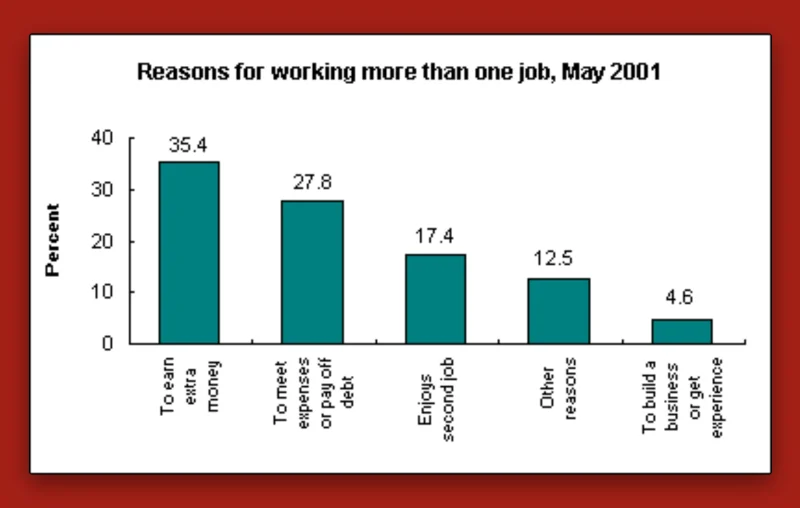
The U.S. Bureau of Labor Statistics even found that earning more money and paying off debts or upcoming expenses was the #1 reason employees choose to moonlight.
A second job can provide:
- A financial cushion
- Faster debt repayment
- Emergency savings
- Extra income for major life goals
A survey of over 12,000 people conducted by the U.S. Federal Reserve found that only 63% of Americans would be able to come up with $400 for an emergency payment. That’s a drop from 68% in 2022.
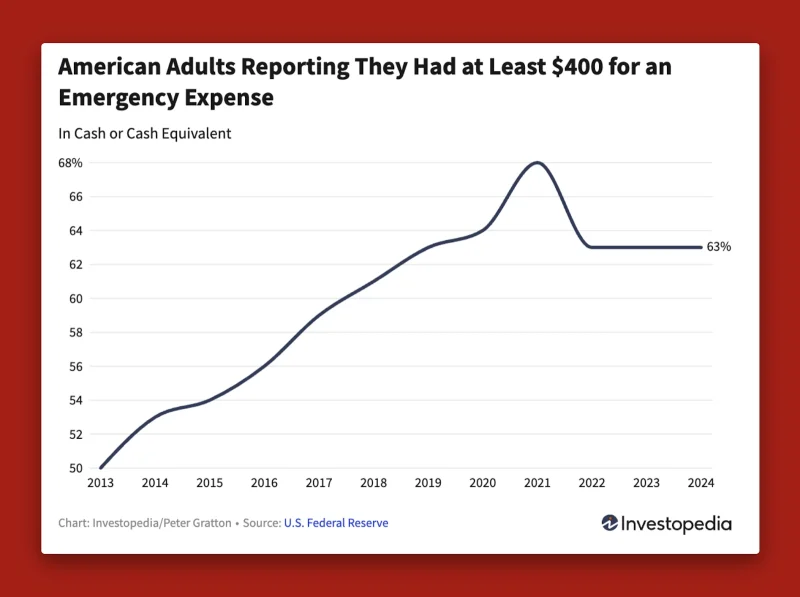
In this context, moonlighting is a way to regain control in an economy that often feels unpredictable.
2. Career security
Job security isn’t what it used to be, either.
Layoffs, restructuring, automation, and shifting market demands have made many employees more cautious. Even high performers know that organizational changes can happen quickly.
So moonlighting is kind of like “professional insurance” for many employees.
By building a freelance client base, consulting network, or secondary income stream, they create a fallback plan. If something happens to their primary job, they’re not starting from zero.
3. Skill development
It’s not as common, but not all moonlighting is financially driven.
Some employees take on outside work to:
- Develop new skills
- Explore different industries
- Build a portfolio
- Test a business idea
- Expand their professional network
For example, a marketing manager might freelance in UX design to broaden their expertise.
A software engineer might build a SaaS product on the side to explore entrepreneurship.
A finance professional might consult for startups to gain exposure to new business models.
In these cases, moonlighting is a way to experiment and be creative without quitting a stable job.
4 Different Types of Moonlighting
1. Passive side income
This is the lowest-friction form of moonlighting.
Passive income streams don’t require the consistent, scheduled hours a second job would. Instead, they’re built once and maintained over time.
Examples include:
- Selling digital products (templates, courses, e-books)
- Monetizing content through ads or affiliate links
- Investing in dividend-paying assets
- Licensing creative work
In these cases, the employee isn’t clocking in somewhere else after work. They’re building income-generating assets that operate in the background.
2. Freelancing and consulting
Freelancing is one of the most common forms of modern moonlighting.
An employee may use their existing skills to work with clients outside their primary job. This work often happens in the evenings or on weekends.
Freelancing can be:
- Project-based
- Hourly
- Short-term contract work
- Ongoing client retainers
Unlike passive income, freelancing requires active time and energy. It can enhance skills and professional networks, but it also increases the risk of burnout if not managed carefully.
3. Part-time secondary employment
This is the “traditional” form of moonlighting.
An employee works a structured second job outside regular hours, like:
- Tutoring
- Retail shifts
- Restaurant or service work
- Fitness instruction
- Event staffing
It’s clear hours, a separate employer, and defined responsibilities.
4. Dual full-time roles (“overemployment”)
This is the most controversial category.
Overemployment refers to holding two full-time remote jobs simultaneously. Unlike freelancing or part-time work, these roles may overlap in working hours.
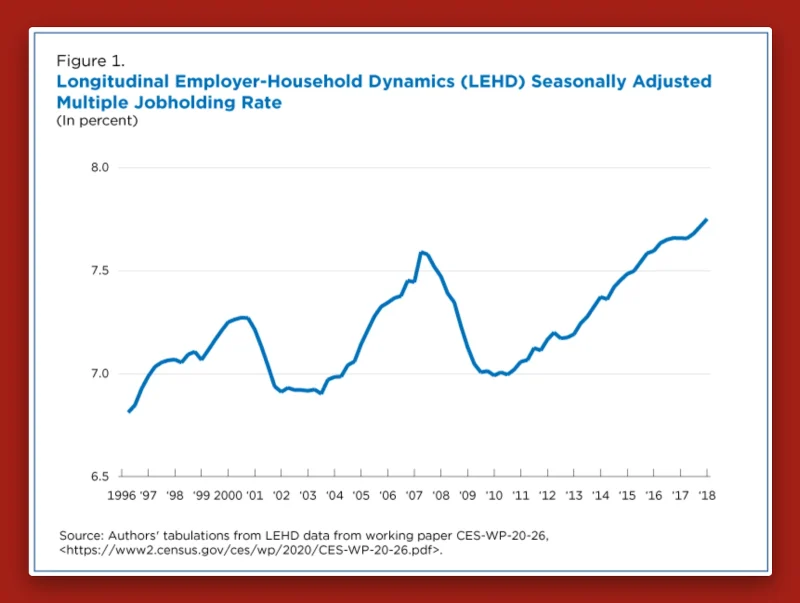
This has always been a thing, but the numbers have increased consistently over the past two decades.
A study from the U.S. Census Bureau found that in Q2 of 1996, the multiple jobholding rate (“moonlighting”) was just 6.8%. In Q1 of 2018, it was 7.8%.
This arrangement typically relies on:
- Remote work environments
- Minimal supervision
- Output-based performance systems
- Careful calendar management
Is Moonlighting Legal?
In most cases, yes—moonlighting is legal in the United States.
There’s no federal law that prohibits an employee from holding a second job. In fact, many workers legally maintain multiple income streams without issue.
But legality doesn’t mean there are no boundaries. You could be liable for maintaining agreements, such as employee contracts and NDAs.
So the real question isn’t just whether moonlighting is legal.
It’s: Does it violate an employment agreement or company policy?
Because your career could be on the line, and lawyers are expensive.
So here’s what to look for in your contracts:
- Non-compete clauses
- Non-solicitation agreements
- Confidentiality or non-disclosure agreements (NDAs)
- Outside employment restrictions
How Employers Should Respond to Moonlighting
Here’s the reality: moonlighting is a signal.
A signal of financial pressure.
Career insecurity.
Shifting work expectations.
Unused capacity.
Whatever it is, the most effective employer response focuses on clarity, performance, and trust.
And if you’re feeling lost or concerned, you’re not alone. Here are some of the most common, effective ways businesses handle moonlighting.
1. Create clear, written policies
Ambiguity creates tension.
If your company has no official stance on outside employment, it’s left up to your employees’ imaginations.
Some will disclose side work. Others won’t.
But inconsistency breeds distrust.
A strong moonlighting policy should:
- Clearly define what qualifies as outside employment
- Outline disclosure requirements (if any)
- Explain what constitutes a conflict of interest
- Clarify whether work for competitors is prohibited
- State how performance expectations apply regardless of outside work
- Legal ramifications if policies are not respected
2. Focus on output, not surveillance
In remote and hybrid environments, especially, excessive monitoring often backfires.
If an employee is meeting deadlines, delivering quality work, and hitting performance benchmarks, is their second income stream really an issue?
(Spoiler: it’s usually not.)
Instead of tracking activity hours or installing invasive monitoring software, companies should:
- Define measurable outcomes
- Align teams around clear KPIs
- Hold employees accountable to performance standards
Performance speaks for itself.
3. Address root causes
If multiple employees are moonlighting, it’s worth asking why.
Are compensation levels competitive?
Are workloads reasonable?
Do employees feel secure in their roles?
Is there a lack of growth opportunities?
Sometimes moonlighting signals financial strain. Other times, it signals disengagement or underutilization.
Proactive employers examine internal factors before assuming bad intent.
In some cases, offering clearer career paths, internal mobility, or flexible work arrangements can reduce the need for outside work.
Or at the very least make it transparent.
4. Encourage open conversation
Punitive reactions push moonlighting underground.
If employees fear automatic termination for disclosing side work, they’re less likely to be transparent. That increases risk for everyone.
Instead, employers can foster a culture in which outside work is discussed openly, but within reasonable boundaries. That might look like:
- A simple disclosure process
- Case-by-case review of potential conflicts
- Clear communication about what is and isn’t acceptable
5. Protect what truly matters
Let’s face it: as an employer, you have legitimate interests to safeguard:
- Confidential data
- Intellectual property
- Client relationships
- Team performance
And if you’re an employee reading this, it’s important to remember this.
Policies and conversations should center on these priorities. Ask yourself what you need to protect the most. If it doesn’t affect any of those things, live and let live.
How Employees Can Moonlight Responsibly
Now, I want to talk to the employees—or moonlighters—here.
Let’s start with a blunt truth: moonlighting can become risky if handled carelessly.
If you’re considering taking on a second job, freelance clients, or launching a side business, the key isn’t secrecy. It’s strategy.
Responsible moonlighting protects your income, your reputation, and your long-term career.
With that being said, here are a few ways you can do all of the above and still get your coin.
1. Review your employment agreement first
Don’t even think about accepting outside work without revisiting your employment documents.
More specifically, look for:
- Non-compete clauses
- Outside employment restrictions
- Conflict-of-interest policies
- Confidentiality agreements (NDAs)
Some companies prohibit working for competitors. Others require written disclosure. Some place no restrictions at all.
Don’t assume. Verify.
Violating a signed agreement can lead to termination, even if your side work seems harmless.
2. Avoid direct competitors
Even if your contract doesn’t explicitly ban it, working for a direct competitor is one of the fastest ways to create ethical and legal complications.
The issue isn’t just perception. It’s flat-out risk.
Employers are understandably protective of:
- Proprietary processes
- Client lists
- Pricing strategies
- Product roadmaps
- Internal data
Keeping your outside work in a different industry or niche dramatically reduces the potential for conflict.
3. Never use company resources
This should be obvious, but it’s worth mentioning anyway.
Do not use:
- Your company laptop
- Internal software
- Work time
- Confidential documents
- Employer-paid subscriptions
Even small overlaps can create serious problems if discovered.
Keep your work environments completely separate—physically and digitally.
4. Protect your performance
If your primary job starts slipping, your moonlighting strategy isn’t sustainable.
Late deadlines, reduced responsiveness, and declining quality are red flags. Even if outside work is technically allowed, poor performance can still result in disciplinary action.
5. Manage time and energy realistically
When we discuss moonlighting, we’re talking about a stamina challenge.
Ask yourself:
- Can I maintain this long-term?
- Am I sacrificing sleep, health, or relationships?
- Is the financial gain worth the stress?
Short bursts of extra work may be manageable. But permanent overload rarely is.
So responsible moonlighting always includes protecting your physical and mental well-being.
6. Understand the tax implications
Extra income is always great. Extra tax responsibilities? Not so much.
(This also tends to be the part that creeps up on people late into the game because it didn’t cross their minds before starting.)
Freelance or contract work may require:
- Quarterly estimated payments
- Self-employment tax
- Separate bookkeeping
- Expense tracking
Failing to plan for taxes can erase so much of the financial benefit of moonlighting. So when in doubt, consult a tax professional and research, research, research.
Conclusion
Moonlighting has been around for ages. But it’s more popular (and more accessible) now than ever.
When businesses and employees work together to prioritize clarity, performance, and transparency, managing multiple jobs doesn’t have to create conflict.
| This article is part of Buildremote’s contributor series. Occasionally, we’ll share other people’s ideas about running a remote company. If you have a topic you’d like to pitch for Buildremote, send us an idea here. |
